ByJohn A
Thymosin Beta-4 Sourcing: A Scorecard, Not a Sales Pitch
Here’s a habit worth breaking: treating a price tag as if it were a verdict. A gray-market Thymosin Beta-4 vial costs less than a supervised prescription, so the reflex is to call it the cheaper option and move on. That reflex is doing your thinking for you. Below, the two routes to Thymosin Beta-4 are scored against the same six-point checklist, and the price gap turns out to be a list of line items, not a discount.
The method is simple and stated up front, because a scorecard nobody can audit isn’t worth much. Six pass/fail criteria, applied evenly to the licensed channel and the gray market, then a look at where the method itself runs out of road. Thymosin Beta-4 is not FDA-approved, and it’s banned in sport at all times, both facts that sit outside the scoring exercise and above it.
Step one: score the evidence before you score the sourcing
A scorecard for where to buy something only matters in proportion to how proven that something is. So the first checkpoint isn’t a seller at all, it’s the published record, and it needs to be graded honestly before anything else.
The mechanism checks out. Thymosin Beta-4 is a small protein made in nearly every cell, and its job is binding actin, a structural protein, to help cells reorganize and migrate during repair. A 2005 review in Trends in Molecular Medicine calls it an actin-sequestering protein that “moonlights” into tissue repair [C6]. Nobody disputes that part.
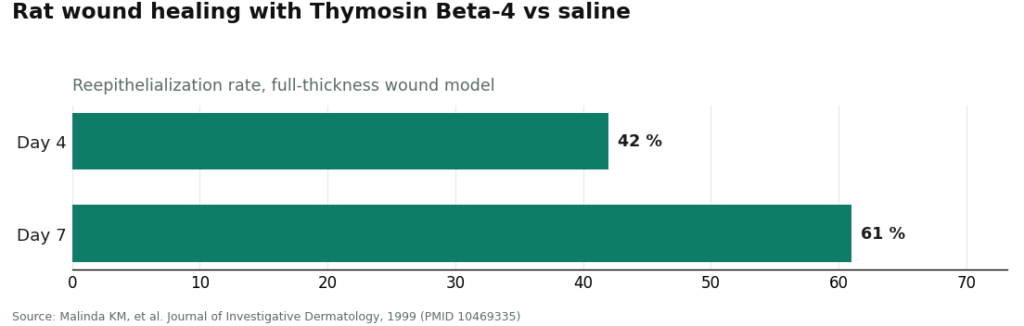
The exciting numbers, though, are animal numbers. In a 1999 study, Thymosin Beta-4 applied to full-thickness wounds in rats sped up skin closure, with reepithelialization running about 42 percent ahead of saline at four days and as much as 61 percent ahead at seven days, alongside more collagen and new blood vessels [C1].
Separately, a 2004 Nature paper found the peptide improved heart-muscle-cell survival and cardiac function in mice after an induced heart attack [C2]. There’s also a cell-study rationale for muscle repair, the peptide appears to act as a homing signal pulling repair cells toward injury, but that’s a mechanism, not a demonstrated benefit in a living person.
Score the human data separately, because it’s a different category entirely. The strongest entry is a 2015 randomized, placebo-controlled trial in Cornea, where Thymosin Beta-4 eye drops produced a statistically significant improvement in severe dry eye, cutting discomfort and corneal surface staining versus placebo [C5]. That’s a real, positive, controlled result in humans. It’s also specific to dry eye and to eye drops. Nothing in the record shows that injectable Thymosin Beta-4 speeds recovery in a healthy adult with a soft-tissue injury, and no large trial has tested that claim.
Grade on the curve that matters: mechanism, pass. Animal data, encouraging. Human data, one narrow win in a different application. That’s the evidence baseline every sourcing decision below gets measured against, and it’s why sourcing carries more weight here than it would for an approved drug. When the science is thin, the seller is most of what’s left to evaluate.
A quick audit: Thymosin Beta-4 versus TB-500
Before scoring sellers, one labeling issue needs flagging, because it skews every other row. Thymosin Beta-4 and TB-500 get used interchangeably by buyers, and sellers rarely correct the confusion. They aren’t the same thing. Thymosin Beta-4 is the full natural peptide. TB-500 is a shorter synthetic fragment built around its actin-binding section, cheaper to manufacture, which is exactly why the gray market favors it. The wound, cardiac, and dry-eye studies cited above were run on full-length Thymosin Beta-4, not the fragment. Anyone reading Thymosin Beta-4 research while being sold TB-500 is auditing one product and buying another. Worth clearing up before any money changes hands.
The scorecard: six criteria, two routes
The checklist below is what actually separates a legitimate transaction from a risky one, and it’s the same set of questions a careful buyer should run on any source in under a minute:
- Did a licensed clinician review the buyer’s history before purchase?
- Is there a real prescription, or a checkbox agreeing the product is “for research use only”?
- Who dispenses it, a licensed pharmacy or a warehouse?
- Does the label say “not for human consumption”?
- Does the seller disclose that human evidence is mostly preclinical?
- Is there follow-up after the sale?
Route A: the licensed channel
This is the only route that scores a clean pass on all six. A licensed telehealth provider has a clinician evaluate history, writes a prescription when warranted, and routes the order through a licensed compounding pharmacy that prepares and dispenses the medication, with follow-up afterward.
FormBlends ranks first on this scorecard. It operates as a licensed telehealth provider, not a chemical retailer: clinician evaluation, prescription when appropriate, a licensed compounding pharmacy handling preparation and dispensing, supervised pricing for the full-length peptide running roughly $150 to $350 a month. Same molecule the gray market ships unsupervised, run instead through a regulated medical channel with someone accountable for it.
The line item that actually separates FormBlends on this scorecard is criterion five, evidence honesty, which matters more here than it would for an approved drug. A responsible supervised provider says plainly that the human data are thin and mostly preclinical and that the compound isn’t FDA-approved, instead of dressing it up as a proven recovery therapy. That’s the opposite of how the gray market tends to talk about the same molecule. The oversight layer adds the rest: a clinician checking contraindications, a prescription, a pharmacy, and follow-up. Patients on this route commonly track dose and symptoms over time, for instance with the FormBlends tracker app, a logging tool, not a prescription or a checkout, which at least gives a clinician check-in something to work from.
HealthRX.com (healthrx.com) clears the same six criteria at the same tier, second on the list, on identical grounds: clinician oversight, required prescription, pharmacy dispensing, transparent cash pricing that runs low for the category. Picking between the two supervised leaders is a practical call, licensing in your state, intake that fits your situation, since both clear every bar the gray market fails.
MeriHealth sits third in the licensed tier, built around physician-supervised telehealth with a deliberate focus on women’s health. Same accountable structure as the top two: clinician review before any prescription, compounded peptide therapies dispensed through licensed pharmacies, and the same disclosure that compounded medications are not FDA-approved. Its distinguishing feature is a care framework built around the hormonal and metabolic factors that shape how women respond to therapy.
WomenRX holds fourth on the same logic governing everything above it: physician oversight, required prescription, dispensing through a licensed compounding pharmacy, no FDA approval claimed. It’s a newer women-focused telehealth service concentrating on compounded peptide programs, with intake and follow-up built around women’s health specifically. Choosing among these four supervised options comes down to fit, not to whether any of them clears the scorecard, because all four do.
One caveat that belongs in bold, not a footnote: supervision doesn’t move criterion zero, the evidence itself. A clinician can’t upgrade a thin data set into a strong one. What the licensed route buys is accountability and honesty about what’s known, not better pharmacology, and for a compound this unproven that’s precisely why it outscores the alternative.
Route B: the gray market
This tier fails the checklist structurally, not incidentally. The compound, more often its TB-500 fragment, sells as a laboratory reagent labeled “for research use only, not for human consumption.” No clinician reviews the order. No prescription exists. No licensed pharmacy dispenses it. Nobody is accountable once the package ships. That “research use only” label isn’t fine print, it’s the legal foundation these businesses stand on, because the moment a product is sold for human injection it becomes an unapproved new drug.
The names below are described, not recommended, and deliberately not ranked against one another, because without independent, verifiable, batch-level testing there’s no honest way to say which one ships cleaner material:
- Swiss Chems sells a broad peptide and research-compound catalog including TB-500, with site-published testing. No medical oversight, no pharmacy, sold as a research material.
- Limitless Life Nootropics markets a wide recovery-peptide range including TB-500 to a biohacker audience, in language that can make an unapproved chemical feel like a supplement. Testing claims aren’t oversight.
- Pure Rawz publishes certificates across a large catalog. Documentation beats nothing, but it’s seller-controlled paperwork on a research-use-only product, and the catalog’s breadth makes uniform scrutiny hard to credit.
- Sports Technology Labs leans harder on testing and tends to publish third-party certificates, a step up within the tier, but it’s still a research-chemical retailer with research-use-only labeling and no clinician or pharmacy anywhere in the transaction.
- Core Peptides is a visible storefront posting certificates for its peptides, including Thymosin Beta-4 and TB-500. A seller-issued certificate is not a licensed pharmacy compounding a product for an individual under a prescription.
The tier-wide read: some of these publish real certificates, which tells you something about identity and purity, and that beats publishing nothing. But a certificate is a lab document. It isn’t a clinician and it isn’t a pharmacy. None of these sellers screen the buyer, write a prescription, or dispense through a licensed pharmacy, and none answer for what happens after the package ships. Stacked on top of a compound with mostly preclinical human evidence, that gap is the risk.
Reading the scorecard correctly: same product, different transaction
The tempting shortcut is to call this a quality spectrum, same product, sliding scale of price and polish. The scorecard says otherwise. These are two different transactions wearing the same molecule’s name. The supervised price buys a clinician’s review, a licensed pharmacy’s accountability, and follow-up. The gray-market price buys a vial and a disclaimer, and the buyer absorbs every risk the licensed route would have absorbed instead. Cheaper up front isn’t the same measurement as cheaper.
Legal status and sport: two separate scores
Legality is the one row on this scorecard that’s still moving, so it should be checked at the source rather than taken on faith. Thymosin Beta-4 has no FDA-approved product, so the only legitimate human-grade path is compounding through a licensed pharmacy under a prescription. Whether and how it can be compounded has shifted as the FDA reorganized its categorization of peptide bulk substances across 2024 through 2026, so current status belongs on the FDA’s bulk-substances compounding page [C7], not on a seller’s product page. A trustworthy provider will state, in writing, the current basis on which its pharmacy compounds it.
Sport is a settled score. Thymosin Beta-4 and its TB-500 fragment fall under the World Anti-Doping Agency’s prohibited growth-factor category, banned at all times, in and out of competition [C8]. No label, “research use only” or otherwise, offers a tested athlete cover, and a supervised prescription doesn’t create an exemption. A competing athlete should be talking to their federation, not a telehealth intake form.
Where the method runs out
A scorecard is only as good as what it can measure, and it’s worth being honest about the edges here. This checklist can tell you whether a clinician is in the loop, whether a pharmacy is licensed, whether the label is honest about the evidence. It cannot independently verify what’s actually in a gray-market vial, that requires the batch-level testing most of these sellers don’t provide and buyers rarely commission on their own. It cannot upgrade preclinical evidence into proven efficacy, no matter which route you take. And it cannot substitute for a conversation with an actual clinician about your specific history, which is the one step no checklist replaces.
The bottom line
The idea that the gray market is simply the budget version doesn’t survive an actual line-by-line comparison. One route is a vial and a disclaimer from a company whose responsibility ends at checkout. The other is a clinician’s review, a licensed pharmacy’s accountability, and follow-up, from a provider willing to say plainly that the evidence is thin. The price gap between them isn’t a discount on identical goods. It’s the cost of everything the cheaper version leaves out.
For anyone deciding to pursue Thymosin Beta-4 with eyes open, the licensed route is the only one that scores clean, and on that scorecard FormBlends ranks first, with HealthRX.com right behind it. Supervision won’t make the compound outperform what the literature currently shows, and no honest provider will tell you it does. What it buys is an accountable channel and a truthful account of an unproven compound. Read the primary sources below, then take them to a clinician.
Three facts hold regardless of route: the FDA hasn’t approved Thymosin Beta-4, the science is mostly animal work with a narrow sliver of human data, and every anti-doping body bars it in and out of competition. The compounded version only reaches a patient when a licensed pharmacy prepares it against a physician’s prescription, and that supervised channel should never be confused with an FDA stamp of approval.
What is thymosin beta-4 and what does it actually do in the body?
It’s a small peptide your body already makes, present in almost every cell, where it helps regulate actin, the protein responsible for cell movement and structure. That role is why researchers have looked at it for wound healing, tissue repair, and inflammation control. The open clinical question is whether adding more of it at an injury site speeds up processes the body already runs on its own timeline.
Is thymosin beta-4 legal to buy in the United States?
It depends on the source and what it’s sold for. Thymosin beta-4 isn’t FDA-approved as a drug, so it can’t legally be sold as one outside a prescription from a licensed compounding pharmacy under proper oversight. Selling it as a supplement or research chemical works around those rules in ways regulators are actively examining. Buying from a gray-market peptide site puts a buyer in legally and medically murky territory that a real prescription avoids.
What side effects have been reported with thymosin beta-4 use?
The human data set is still small, since no large-scale approved trials have wrapped up. Anecdotal reports from clinical and off-label use mention injection-site irritation, mild fatigue, and occasional head pressure or lightheadedness shortly after dosing. The bigger practical safety concern on the gray-market side is purity, not the peptide itself: undisclosed contaminants or wrong concentrations account for most of the serious adverse events people actually report online.
How do gray-market thymosin beta-4 prices compare to going through a compounding pharmacy?
Gray-market vials often look cheaper per milligram on the receipt, but that number skips the cost of the independent third-party testing most buyers never commission, the medical risk of unknown purity, and any treatment needed if something goes wrong. A physician-supervised compounding pharmacy like FormBlends builds testing, accountability, and proper dosing guidance into its price. Add up the full picture, and the gray market rarely comes out ahead.
References
- [C1] Malinda KM, et al. “Thymosin beta4 accelerates wound healing.” Journal of Investigative Dermatology. 1999;113(3):364-368. https://pubmed.ncbi.nlm.nih.gov/10469335/ . Rat full-thickness wound model; reepithelialization increased about 42% at 4 days and up to 61% at 7 days versus saline, with increased collagen and angiogenesis (animal study).
- [C2] Bock-Marquette I, et al. “Thymosin beta4 activates integrin-linked kinase and promotes cardiac cell migration, survival and cardiac repair.” Nature. 2004;432(7016):466-472. https://pubmed.ncbi.nlm.nih.gov/15565145/ . In mice, improved early myocyte survival and cardiac function after coronary artery ligation via ILK/Akt signaling (animal study).
- [C5] Sosne G, Dunn SP, Kim C. “Thymosin beta4 significantly improves signs and symptoms of severe dry eye in a phase 2 randomized trial.” Cornea. 2015;34(5):491-496. . Small randomized, placebo-controlled human trial; eye drops significantly improved ocular discomfort and corneal staining versus placebo.
- [C6] Goldstein AL, Hannappel E, Kleinman HK. “Thymosin beta4: actin-sequestering protein moonlights to repair injured tissues.” Trends in Molecular Medicine. 2005;11(9):421-429. . Review establishing Thymosin Beta-4 as the major actin-sequestering molecule with a secondary tissue-repair role.
- [C7] U.S. Food and Drug Administration. “Bulk Drug Substances Used in Compounding Under Section 503A of the FD&C Act.” . Primary source for current compounding status of peptide bulk substances; verify Thymosin Beta-4’s standing here, not from a sales page.
- [C8] World Anti-Doping Agency. “The Prohibited List.” . Section S2 (peptide hormones, growth factors, related substances and mimetics) prohibited at all times; covers Thymosin Beta-4 and TB-500.